

Which Jensen Huang Nvidia Scandal Did You See?
A spy plot, an affair, a trillion-dollar selloff, a national security threat, a smear, a founder pushed out. In less than three weeks the same story was all of them, and the one you got depended on where you were reading.

As I write this, more than 70 Wikipedia editors are arguing about what to call the thing that has been happening at Nvidia. The article is titled "Jensen Huang spying scandal" for now, and the discussion about renaming it has passed 180 comments. One camp says "spying" makes it sound as if Huang was the spy. Others want "spying allegations," "affairs scandal," "2026 Nvidia leadership crisis" or "Jensen Huang ouster from Nvidia." Nobody in that thread disagrees much about the facts. What they disagree about is which fact the story is about.
And it isn’t only Wikipedia. If you've talked about Nvidia with anyone lately, you may have noticed you weren't talking about quite the same thing. One of you was following a spy thriller, another a story about a marriage, and somebody else was mostly checking their retirement account. All of them are real parts of what happened, and which one you got first had less to do with the facts than with who you heard it from.
One man, several stories
The spy story came first. On October 29, the New York Times reported that US officials saw Huang as the target of a Chinese intelligence plot, and a week later it reported a government memo saying China's Ministry of State Security had recruited the woman involved, an executive at a Singapore company that buys Nvidia's chips. That version has had doubters from the start. Representative Jim Himes said after a classified briefing that he doubts she's a spy, CNN reported that the intelligence community isn't sure either, and on November 16 the President joined them: "I don't know that she is a spy."
Then it became a story about a marriage. On November 8, Huang told employees he had been unfaithful, writing, "There is no excuse for what I did." Within days, the Times and Reuters reported relationships with two Nvidia employees, one of whom reported to him.
For anyone who owns the stock, it was a story about money, and even the money depends on when you start the clock. Yahoo Finance's live blog put the loss at $490 billion in a single week, or about $1.75 trillion since the stock's peak on October 5. Both are right, and the one you pick decides how big the headline sounds.
On November 12, Huang resigned. Nvidia's filing and statement gave no reason, and President Trump posted that the only man who could take his place was Tim Cook: "A Legend replaces a Legend!"
In Washington, where export controls are made, it became a story about the administration. Treasury Secretary Scott Bessent blamed the Commerce Department for not restricting the Singapore company sooner ("Commerce has the pen"), and the Washington Post worked out from disclosed trades that Trump held as much as $62 million in Nvidia stock as of August. The White House says independent managers run his portfolio.
In Beijing, it was a different story entirely. China's Foreign Ministry called the allegations "purely unsubstantiated and directed at smearing China," and the state-run Global Times wrote that "this is precisely how the U.S. media, which has always prided itself on being 'objective,' fabricates stories."
And in Silicon Valley, the story became a campaign. Epic Games' Tim Sweeney called the resignation "a sad day for NVIDIA, developers, America and all humanity," and by Saturday he and Elon Musk had signed a petition asking the board to "bring him back while an independent investigation establishes the facts." It passed 170,000 signatures by Monday. The Financial Times reported that Huang had discussed a comeback with allies, and Trump said he "would not mind." The board, according to a person who spoke to CNBC, isn't considering it.
Nobody had to lie for this to happen
It's tempting to call all this spin, and some of it is. The Global Times speaks for a government that denies any role in the story, and its framing reads exactly that way. But most of the difference comes from ordinary editorial judgment. A business desk writes for readers who own the stock, a national-security reporter covers China, a gaming site asks whether graphics cards will finally get cheaper (sadly, no), and an investor on X admires what Huang built. Each of them picks the part of the story their readers care about most, and every one of those choices leaves something, or someone, out.
You can watch it happen in the headlines, which spent the weekend telling readers what the story is really about. A Times opinion piece was titled "The Nvidia Spy Case Is About Much More Than Sex." The Washington Post said Nvidia's "bigger issue could be chip smuggling," and CNN said "the real stakes are much bigger." Mediaite even ran a headline pointing out that right- and left-leaning outlets both put Trump at the center of the scandal, "but For Different Reasons." None of them is wrong, and a story this big has room for all of them. The trouble starts when you only get one.
The story wouldn’t sit still
Zetfeed keeps track of what’s trending across the feeds it follows, so we got to watch this story change as it happened.
At first the spy story barely caught on. When the Times broke it, our feeds picked it up for a couple of days and then moved on to other things. What finally set it off was Huang admitting the affair to his staff. Within a day he was all over our feeds, and by the time he resigned he was the biggest story we had, and the conversation had moved on to who would run Nvidia next.
Over the weekend the story began to fade, until Monday, when it picked up again over whether Nvidia should bring him back.
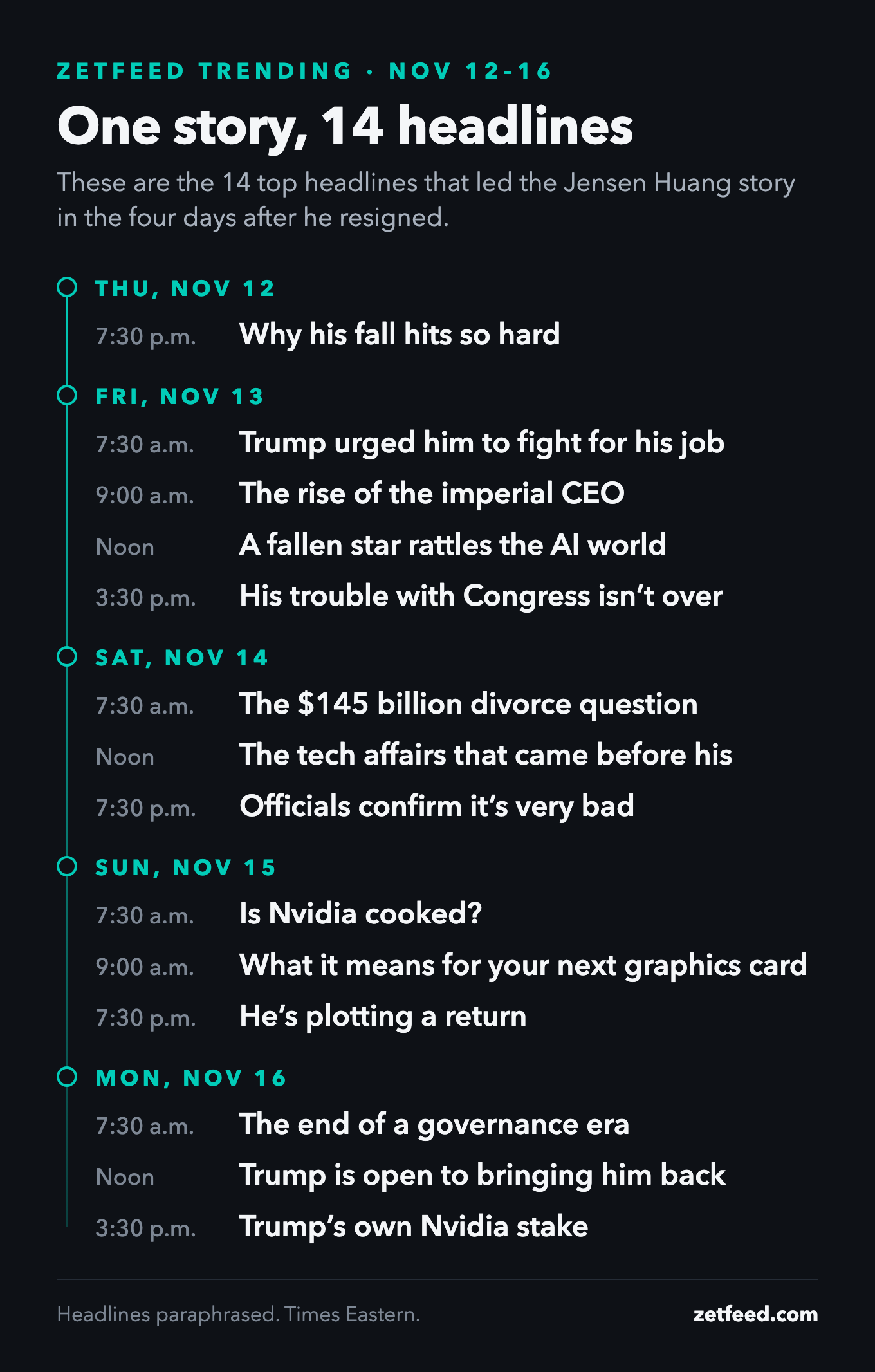
The clearest sign of all this is the top spot on our trending list, where each big story is led by whichever headline our system rates highest at the moment. In the four days after Huang resigned, the top story was led by 14 different headlines, from the imperial CEO and a $145 billion divorce question to whether Nvidia is “cooked,” a comeback plot and Trump’s own Nvidia stock.
Where you read it decided which version you got
Two things make this harder than it used to be. More of us now get news from people rather than newsrooms: Pew found that 21% of US adults regularly get news from news influencers, 77% of whom have no background at a news organization. An influencer hands you one framing plus their own take on it, which is pretty much what the reaction on X looked like this week. And social and video platforms are now the most common way people reach news online, according to the Reuters Institute. A feed that learns from what you click will tend to show you more of whichever version you clicked last.
So the fix is a little boring. For a story like this, read it on purpose from more than one kind of source: a business paper like the Financial Times, a wire service like Reuters, a foreign-affairs magazine like Foreign Policy, the South China Morning Post for a view from Hong Kong, and a tech site like The Verge. Or open a whole topic, like Business or World News, and pick a few you wouldn’t normally read. You don’t have to agree with all of them to learn something from the places where they disagree.
The Wikipedia editors were still arguing when I finished writing this, and they aren't the only ones who can't settle on a version. The Denny's in San Jose where Nvidia's founders talked through the idea for the company took down its plaque marking the booth, then announced it was putting it back. I hope the editors take their time, because the argument tells you more about this story than any one title could.